

Solving Open Research Problems Together
Mathematicians and Muse Spark collaborate on six research papers
Earlier this year, our models achieved gold-medal-level performance across five high-school Olympiad competitions in mathematics, physics, and chemistry. Those results inspired us to see whether AI could also help scientists solve open research problems.
Competition problems can be incredibly difficult, but those problems already have a solution. Open research is different. There is no answer key, no guarantee that an approach will work. Making progress means trying and retrying ideas, making new mistakes and resolving them, and sometimes going back to the beginning.
Over the past several months, we've partnered with mathematicians to explore problems across several areas of mathematics. They used both Muse Spark 1.1 and 1.2 in Thinking Mode through the regular meta.ai chat interface, with no custom research scaffold.
Open research takes time. Our goal here wasn't to mass-produce papers, but to empower researchers and help them develop mathematical insights that others can understand and build on. We’re proud to partner with the scientific community to help them advance research. These collaborations were done under the following principles:
- A team of mathematicians guided the research and worked with Muse Spark to explore ideas and develop the arguments.
- A second group of mathematicians then reviewed their work.
- Each paper clearly marks which passages were primarily drafted by researchers and which were drafted by AI.
- Each paper gives credit to the earlier research and mathematical ideas it builds on.
Today, we're sharing six such papers from that collaboration. Five present answers to previously open research questions.
After completing our work, we learned that other teams outside Meta had independently announced solutions to some of the same problems using different approaches. We recognize and appreciate their contributions and clearly acknowledge their work and how it relates to ours in the papers.
Probability: The Strict Threshold for Gaussian Ellipsoid Fitting
Aykut Arslan with Muse Spark via meta.ai. Review by Babak Modami, Alexander Roitershtein, Mark Sepanski, and Grigory Sokolov
Paper: The Strict Threshold for Gaussian Ellipsoid Fitting.
The paper answers a long-standing question about fitting random Gaussian points in high dimensions to an ellipsoid. To visualize the problem in low dimensions, imagine dots scattered on a plane and trying to draw an ellipse centered at a fixed point that passes through all of them. Our main result identifies a sharp threshold for the number of points that can be fitted in this way. Below the threshold, such an ellipsoid exists with high probability; above it, such an ellipsoid almost certainly does not exist. It gives researchers a theoretical benchmark for the limits of exact data fitting, while the behavior exactly at the threshold remains unresolved. Proof strategies were developed and revised with help from Muse Spark, under the guidance of Aykut Arslan, while four other mathematicians on our team checked and refined the arguments. We also acknowledge three independent concurrent works posted in August 2026. Misiakiewicz and Wen independently proved the Gaussian threshold. De la Cerda, Potechin, Tulsiani, and Xu established the Gaussian threshold up to a vanishing multiplicative factor. Koehler and Sohn obtained a broader universality result that includes the Gaussian threshold as a special case. These works and ours were developed independently and use different approaches.
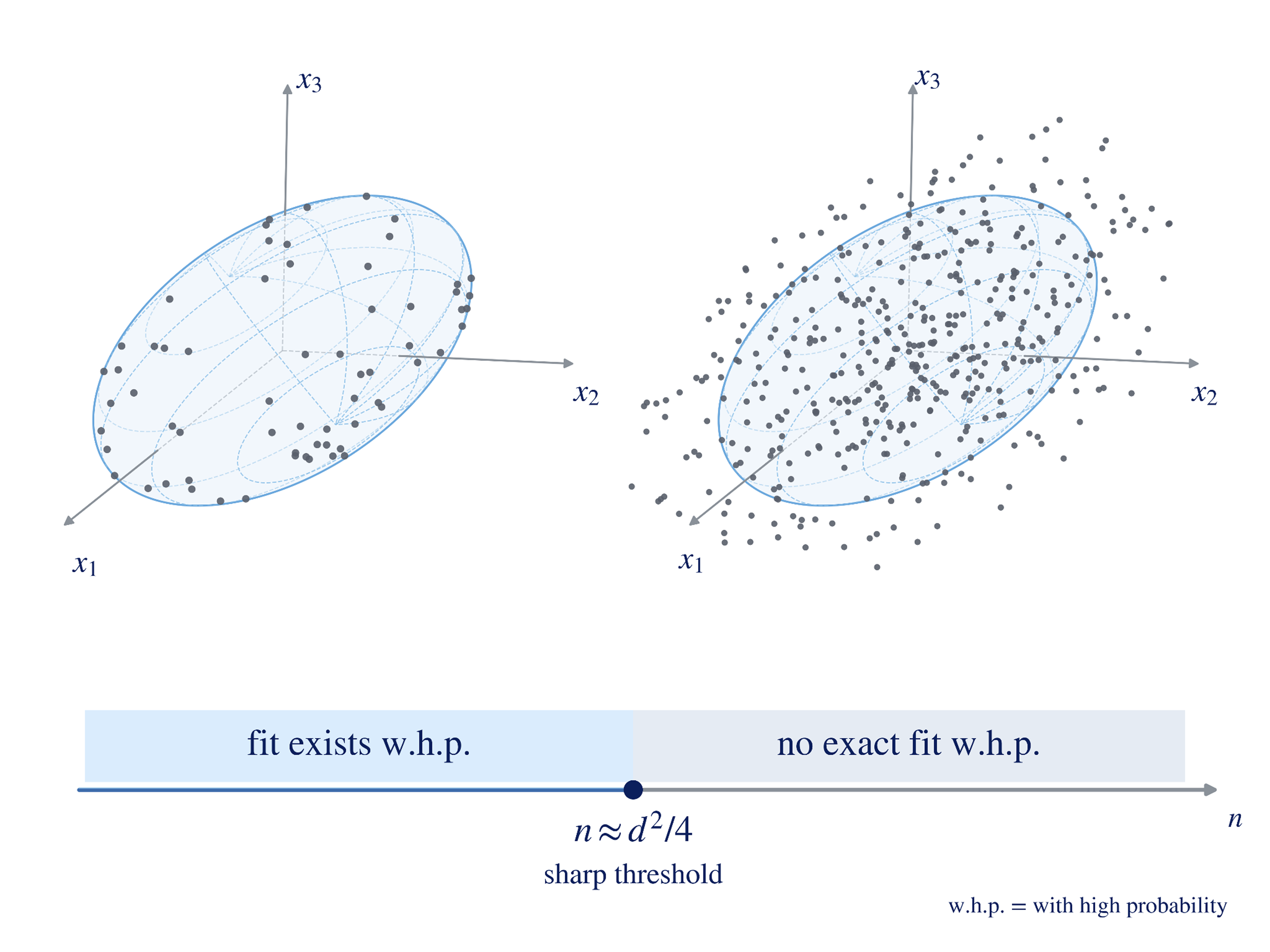
Figure 1: A schematic showing the sharp transition from likely to unlikely exact ellipsoid fitting as the number of random points increases in high dimensions.
Differential Equations: Finite-Time Blow-Up of Radial Negative-Energy Solutions for the Mass-Critical Biharmonic Nonlinear Schrödinger Equation
Leonard Dinh with Muse Spark via meta.ai. Review by Fazel Hadadifard and Salem Selim
The paper answers a long-standing question about wave collapse in a model inspired by laser physics. To picture the problem, imagine a tug-of-war between one effect squeezing a wave inward and another spreading it out. Can the wave keep concentrating forever, or must it eventually collapse? For waves that are symmetric around a center and have negative energy, in two or more dimensions, the paper proves that collapse must happen within a finite time. This settles a question left open in 2015 and confirms a prediction from computer simulations in 2002 for this setting, giving researchers a clearer understanding of when wave collapse is unavoidable. Muse Spark helped work through calculations, test possible arguments, and revise the proof, while Dinh chose the problem and key proof ideas, and a separate pair of mathematicians reviewed and helped refine the work.
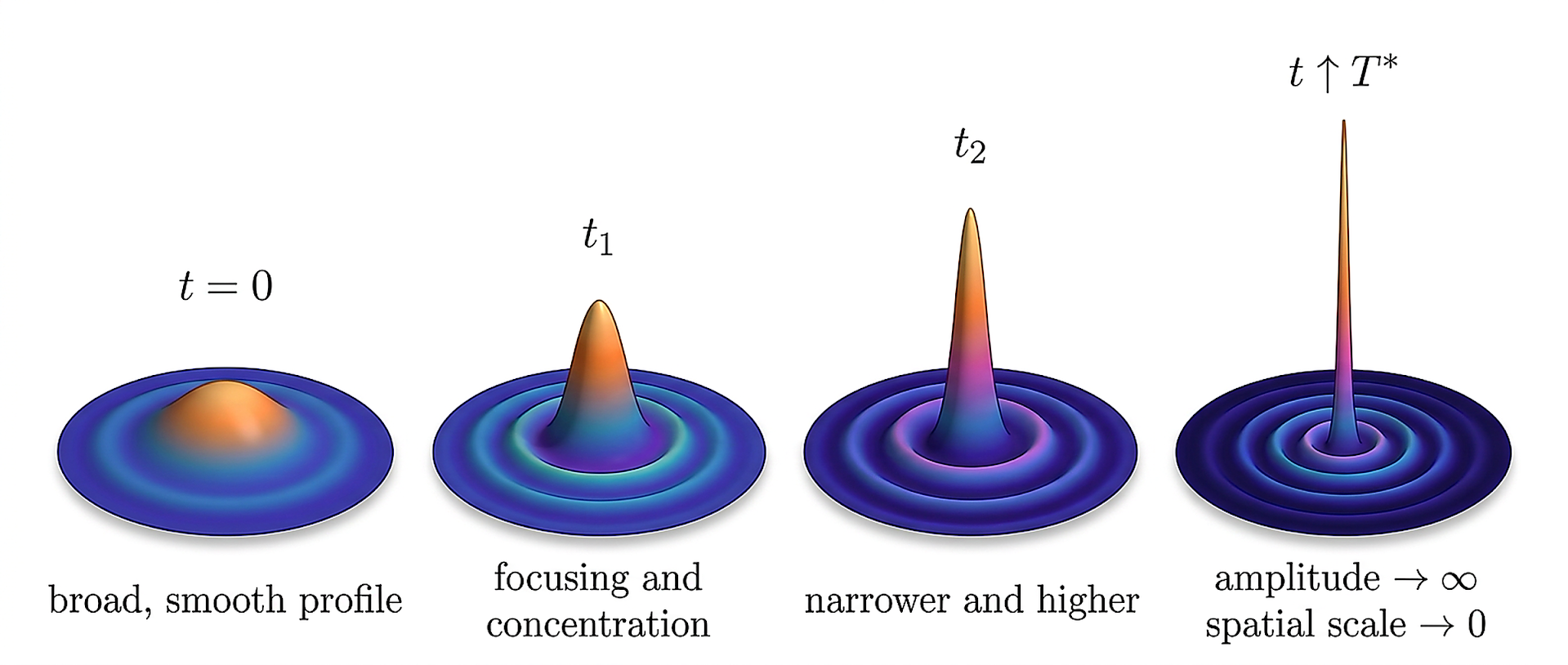
Figure 2: A schematic showing a wave becoming narrower and taller as it approaches finite-time collapse.
Group Theory: Semiabelian Groups Need Not Be Monomial
Joseph Phillip Brennan and Milana Golich with Muse Spark via meta.ai. Review by Andres Barei and John Portin
Paper: Semiabelian Groups Need Not Be Monomial.
The paper disproves a conjecture about groups, mathematical structures used to describe symmetry. First proposed by M. Kida in 2024, it stated that every finite group with a property called "semiabelian" must also have another property called "monomial." Just as finding a black swan disproves the claim that all swans are white, one exception is enough to settle this question. The team found that exception in a group with 384 elements, showing that the two properties do not always go together. This helps mathematicians better understand how these groups are classified. Muse Spark generated the search program in GAP, a mathematical software system, that found the counterexample. Golich and her collaborators verified the result and completed the argument, with two other mathematicians reviewing the work. We also acknowledge the AI agent Nilradical, which reported a different counterexample to the same conjecture on September 16, 2026. Our result was developed independently.
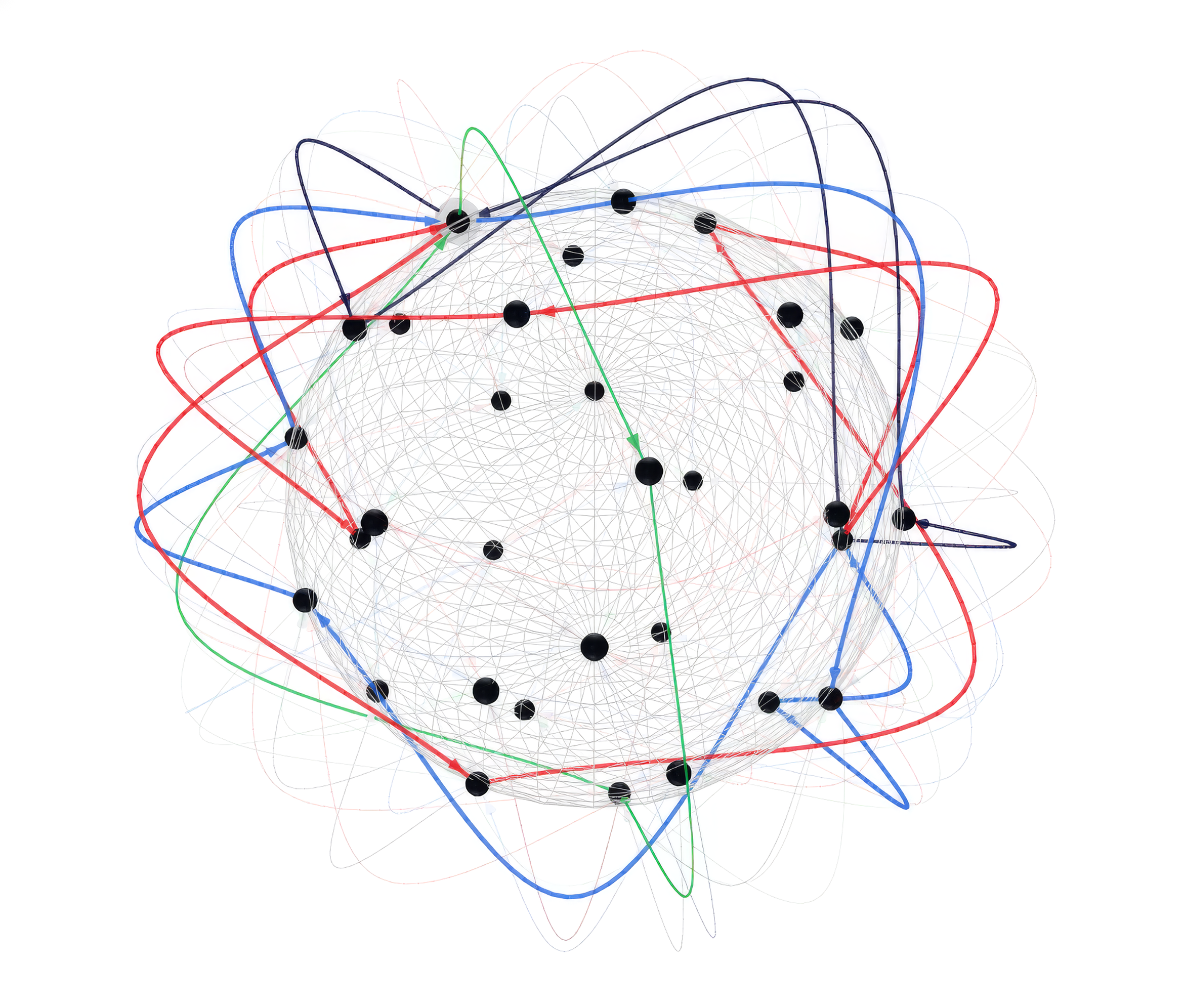
Figure 3: Visual representation of the action of the counterexample of order 384 viewed as a symmetry group.
Optimization: Tightness of the Cycle-Based Relaxation for Completed Length-Three Alpha-Cycles
Aykut Arslan with Muse Spark via meta.ai. Review by Kien Trung Le
Paper: Tightness of the Cycle-Based Relaxation for Completed Length-Three Alpha-Cycles.
The paper answers a question first posed by Del Pia and Khajavirad in 2026 about when a relaxation of a binary polynomial optimization problem captures the original exactly. To picture the structure, imagine three overlapping circles in a Venn diagram, each containing a set of yes-or-no decisions. For the family studied, the approximation is exact when each region shared by two circles (but not the third) contains exactly one decision. If any of those regions contains more than one, the approximation leaves a gap. This gives researchers a clear rule for when this particular simplification loses nothing and when it needs strengthening. Muse Spark helped reframe the problem using probabilities, identify a counterexample, and develop the proof strategy. Arslan and Trung Le checked the arguments, corrected gaps, and refined the final proof.
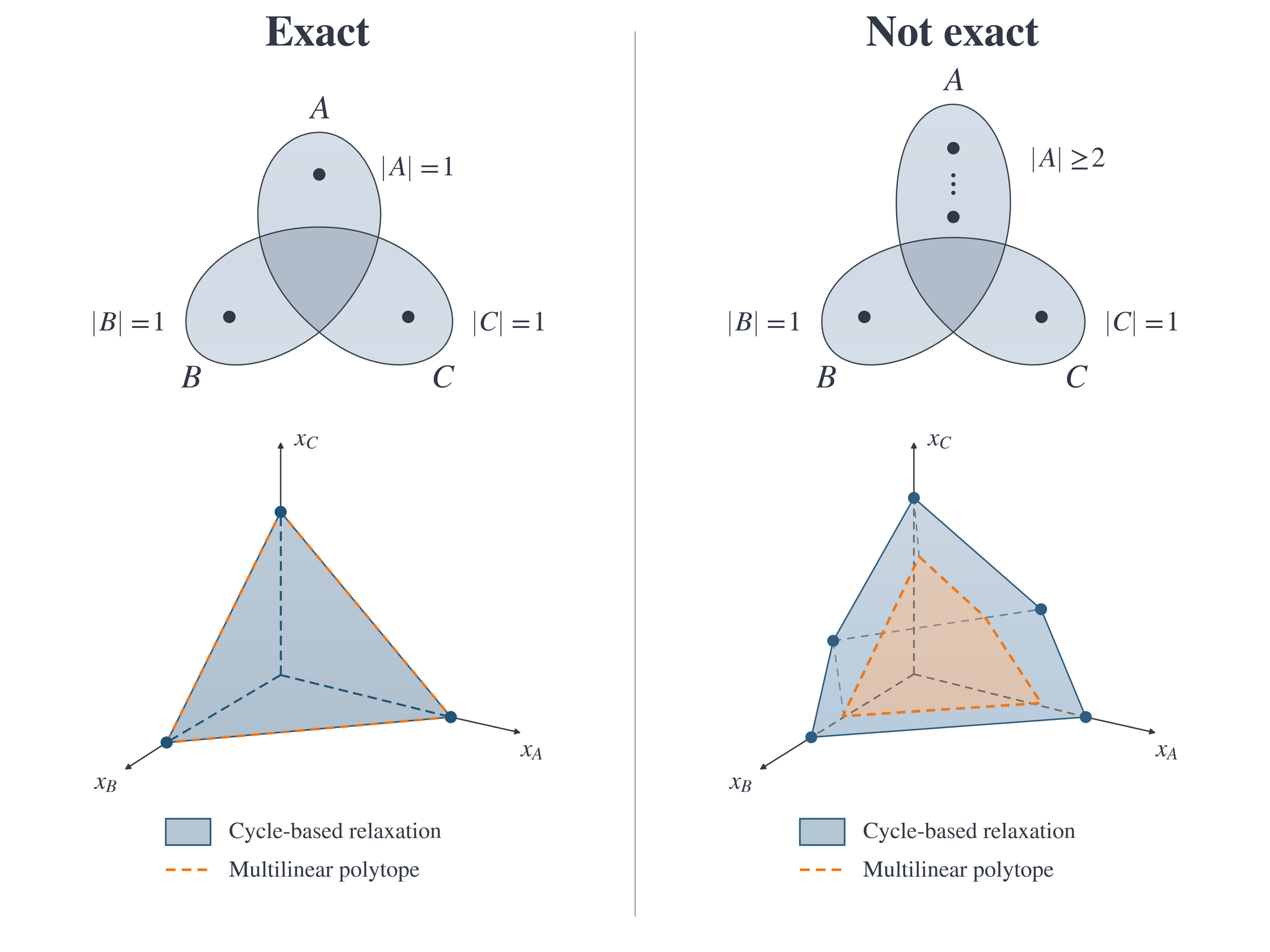
Figure 4: The blue approximation matches the orange exact region on the left but includes extra possibilities on the right.
Arithmetic Physics: String Two-Point Function = Height Function on a Curve
Anindya Dey, Gabriel Herczeg, An Huang, Nicolas Jaramillo Torres, and Jacob H. Swenberg with Muse Spark via meta.ai.
Paper: String Two-Point Function = Height Function on a Curve.
Muse Spark helped researchers connect ideas from two fields (number theory and p-adic string theory), following a direction envisioned by Yuri Manin in the 1980s. Starting from a connection already known for the Tate curve, the model helped the team see how it could extend to a much broader class of curves. The paper shows that two calculations, developed in different mathematical languages, describe the same quantity. In simpler cases, the calculation comes down to counting how many initial digits the coordinates of two points share in a base-p number system. This gives researchers a concrete way to translate ideas and calculations between the two fields. Beyond helping identify the connection, Muse Spark generated candidate proofs and drafted three core technical sections, which the researchers then checked, corrected, and refined.
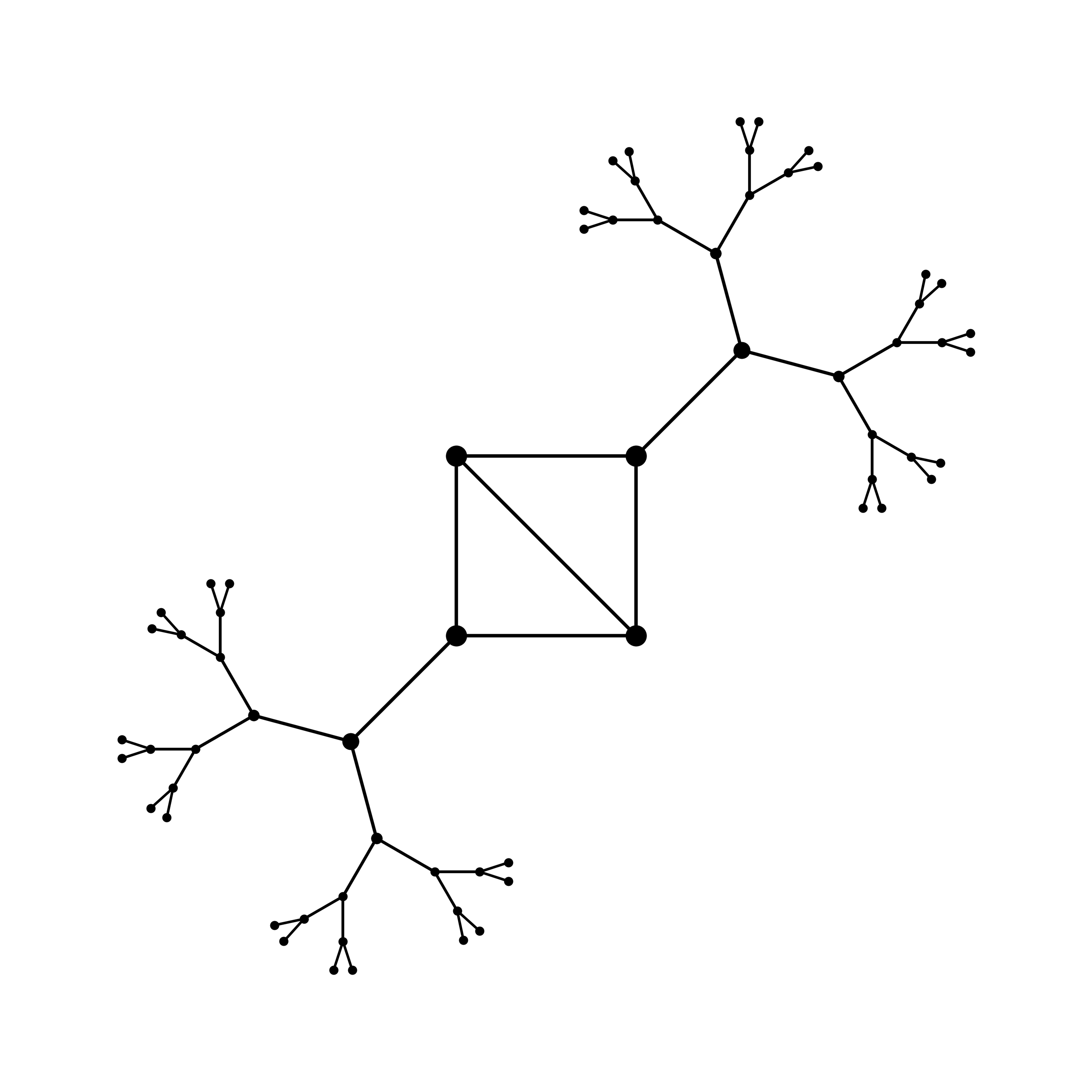
Figure 5: A graph model of a genus-two Mumford curve, with two central loops and trees branching outward.
Non-Associative Algebra: On Solvable Evolution Algebras and a Conjecture by García-Martínez and Pérez-Rodríguez
Andres Barei with Muse Spark via meta.ai. Review by Nicolás Jaramillo Torres
Paper: On Solvable Evolution Algebras and a Conjecture by García-Martínez and Pérez-Rodríguez.
The paper disproves a proposed conjecture for classifying evolution algebras, mathematical structures inspired by evolutionary biology. García-Martínez and Pérez-Rodríguez suggested a test for identifying a class called "solvable" algebras. The team found a small, three-dimensional example that passes their test but does not belong to that class. The paper goes further than finding a counterexample. It establishes an alternative rule that considers whole subspaces rather than individual elements, giving mathematicians a more accurate way to understand these structures. Working from the researchers' prompts, Muse Spark generated the counterexample and proposed alternative characterizations and proofs. Barei checked, refined, and rewrote the material. We also acknowledge independent work by Hu and Wen, who reported counterexamples to the same conjecture.
Building on this work
This work continues our investment in scientific research. We believe progress will require close collaboration between experts and AI, with results that are then carefully verified, transparent in how they were produced, and clearly communicated to the broader research community.
Acknowledgments
We’d like to thank the researchers who brought their questions and expertise to this collaboration, and everyone who checked proofs, and helped make the papers clearer. We're also grateful to the broader mathematics community whose work these results build on.